


[Interview] Keun-ok Yoo, Chairman of Samyoung Machinery
관리자
view : 440
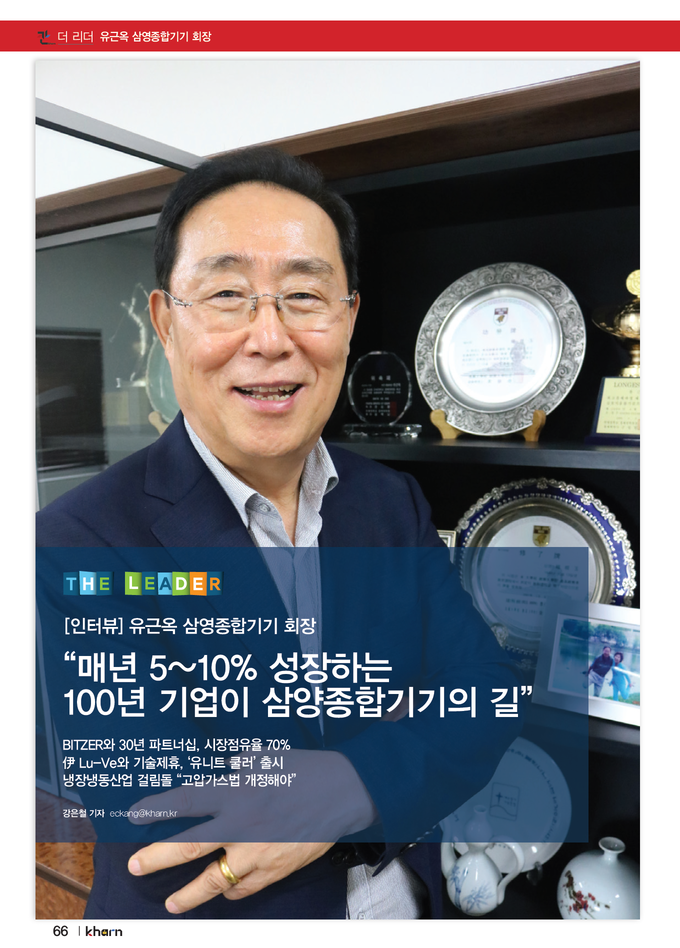
Since its establishment in 1977, Samyoung Machinery has dedicated more than four decades to technological development through continuous cooperation and information exchange with global partners such as BITZER of Germany, LU-VE of Italy, and FU SHENG of Taiwan.
Based on the proprietary technologies and expertise accumulated over the years, the company has created added value in fields including food refrigeration and freezing, general HVAC systems, and industrial plant air-conditioning, backed by proven product quality and reliability. We met with Keun-ok Yoo to hear about the founding of the company and the journey it has taken over the years.
■ What was the business environment like when the company was founded in 1977?
At the time of our founding, Korea’s economy was going through a very difficult period, and the refrigeration, cold storage, and HVAC industries were still in their infancy. Market demand was limited, and imports were not as freely available as they are today, making the business environment quite challenging overall.
■ You have remained in the same industry for more than 40 years.
As an engineer, I believed it was only natural to devote myself to the field in which I had technical expertise. Refrigeration and air-conditioning is a highly specialized industry, and even back then I could see that the market had strong growth potential.
Although overseas travel was not as accessible in the 1980s, I visited HVAC & R exhibitions in advanced countries such as the United States, Japan, and Europe whenever possible. Exposure to new products and advanced technologies was extremely beneficial.
■ There must have been difficult times along the way.
The IMF financial crisis was by far the most difficult period. In the early 1990s, demand and sales for BITZER compressors were rapidly increasing alongside the growth of Korea’s refrigeration and HVAC market. However, the sudden IMF crisis in 1997 created a major challenge for us.
At the time, domestic sales of BITZER compressors were at their peak and had begun surpassing those of Copeland compressors in Korea. However, the sharp rise in exchange rates resulted in foreign exchange losses amounting to approximately KRW 1.5 billion, which was an enormous burden for a small or medium-sized enterprise.
Nevertheless, thanks to the long-standing trust and confidence we shared with BITZER in Germany, we were able to overcome the crisis. Since then, sales of BITZER compressors have continued to grow, and today we hold approximately 70% market share.
■ What has been the most memorable moment?
Since my younger days, I focused entirely on the business and never had time to reflect on whether things were good or difficult. However, in 2017, BITZER and Samyoung held a ceremony at BITZER headquarters in Germany to commemorate the 30th anniversary of our agency partnership.
That event gave me the opportunity to look back on the hardships we overcame and the achievements we built together, making it one of the happiest moments of my life.
■ How do you evaluate Korea’s refrigeration and HVAC industry?
Korea’s refrigeration and HVAC industry has continued to grow every year. As the economy develops and people place greater importance on welfare and health, I do not expect a sharp decline in market demand.
However, competition among companies is becoming increasingly intense. Only companies with strong product innovation and crisis-management capabilities will survive in the long term.
■ What are your main products?
Our core products are BITZER compressors. BITZER’s semi-hermetic reciprocating compressors and screw compressors have achieved the No.1 market share not only globally but also in Korea through outstanding technology and continuous innovation.
Recently, refrigeration and HVAC systems have become larger in scale, leading to increased domestic demand for BITZER screw compressors. In particular, there has been a growing preference for BITZER’s low-temperature HSK/N screw compressor models over Japanese brands such as Kobe Steel, Hitachi, and Mitsubishi Electric, which had traditionally dominated large logistics warehouse projects.
■ What differentiates Samyoung from competitors?
We always strive to manufacture high-quality products. All employees are committed to a quality-first philosophy so that customers can trust Samyoung products regardless of where they are used.
■ What achievements have you made in R&D?
Compact design and high-efficiency products are now global trends. However, many domestic products are still relatively larger than those of advanced global manufacturers, resulting in lower efficiency.
To overcome this limitation, Samyoung has conducted continuous R&D in partnership with LU-VE of Italy for many years. LU-VE operates Europe’s largest R&D center for air-cooled heat exchangers and produces highly efficient products through advanced technologies and continuous innovation.
All LU-VE products are certified by EUROVENT, ensuring reliable performance data.
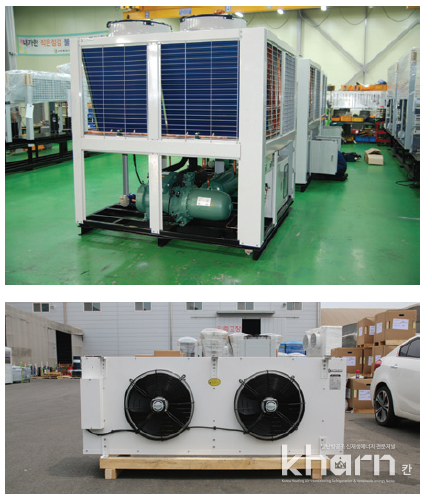
Recently, we have been producing Mini Channel Condensers using 5mm inner-grooved copper tubes, leading the market in compact and high-efficiency product development. Compared to domestically manufactured products, these high-efficiency systems can reduce energy consumption by approximately 20–30%.
Since signing an agency agreement with LU-VE in 1994, Samyoung has supplied unit coolers to various sectors over the past 24 years, including large logistics warehouses, supermarkets, and mushroom cultivation facilities, earning strong recognition for energy-efficient performance.
We believe that energy savings benefit not only customers through cost reductions but also contribute to national interests, which is why we continue to devote our best efforts to developing high-efficiency products.
■ You are also preparing for overseas expansion.
Over the past several years, we have made various efforts to expand exports and improve product quality, including obtaining CE certification. As a result, exports to Southeast Asia and the Middle East have been growing steadily, and we plan to continue expanding further.
Although our overseas marketing and sales activities are still limited, we are seeing gradual growth every year as we work to diversify our markets.
■ You relocated to a new factory.
In August 2015, we expanded and relocated to our current facility in Hwaseong, which includes approximately 4,300 pyeong of land area and 1,500 pyeong of building space.
Our previous Siheung factory had limited space, restricting equipment expansion and production capacity. At the new Hwaseong plant, we have actively utilized the larger facility and installed numerous unmanned automated systems, resulting in improvements in work efficiency, production capacity, and product quality.
■ What are this year’s goals and long-term vision?
Samyoung does not focus excessively on rapid sales growth. A company’s internal stability is the most important factor. Over the years, I have seen many companies collapse due to financial difficulties, and it has always been painful to witness.
Our goal is to achieve steady annual growth of around 5–10%. We do not intend to be overly ambitious. Instead, Samyoung aims to build a company that will last for the next 100 years. Even after my retirement, I have asked our employees to continue building a company capable of planning for the next century.
■ Any final message?
Korea’s refrigeration and HVAC industry is heavily regulated. While high-pressure gas regulations are strict worldwide, Korea’s regulations are particularly severe compared to advanced countries such as Germany and Japan, slowing the industry’s development.
For the industry to advance further, regulatory reform is urgently needed.
In Europe, particularly in Germany, refrigeration systems using CO₂ refrigerants — which offer significantly higher efficiency than conventional refrigerants — are already widely adopted. In Korea, however, widespread adoption is effectively blocked due to regulations such as the High Pressure Gas Safety Control Act.
In Japan, regulatory oversight applies only to systems above 50RT, whereas Korea still applies the standard to systems above 20RT.
As high-efficiency and compact products become the global standard, Korea should also incorporate refrigeration and cooling equipment into high-efficiency equipment management systems or introduce energy-efficiency certification programs.
A market driven solely by price competition ultimately harms consumers and, in the long run, the nation as a whole.
https://www.kharn.kr/news/article.html?no=7705
